AI First Message Flow

  • COMPANY

  • Preply

  • Role

  • Product Designer

  • Type

  • Experiment and AI intro

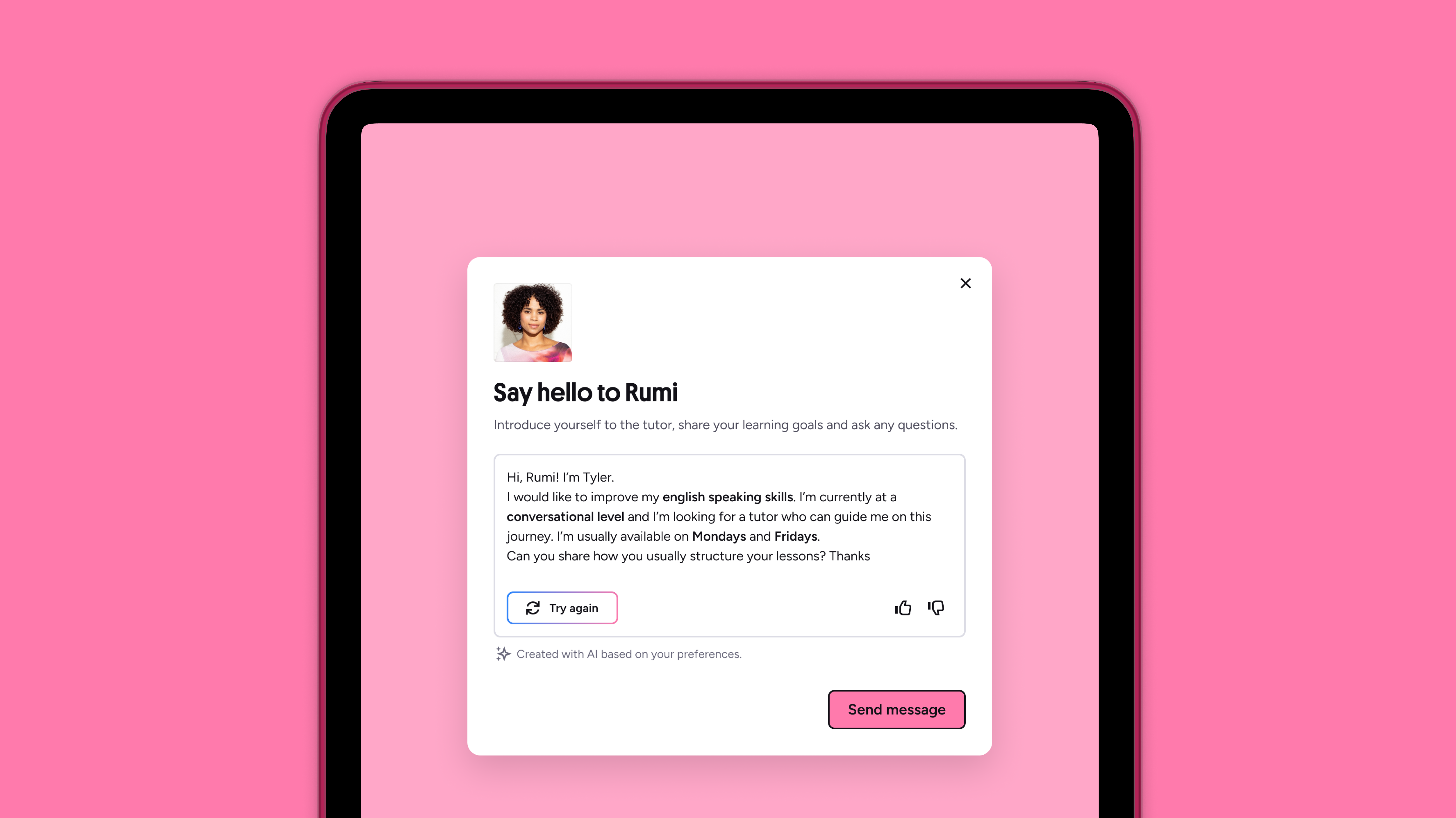
Explored an AI-powered first-message experience to help learners confidently reach out to tutors before booking a trial. The goal was to reduce friction in an underexplored part of the funnel, increase learner confidence, and introduce AI as a supportive, trust-building tool early in the learning journey. This project focused on turning an informal but high-impact behavior into a guided, delightful experience that feels natural, helpful, and fully under user control.
hero-ai-message

The problem


Many learners contact tutors before booking a trial as a way to assess fit, clarify expectations, or introduce themselves. These conversations strongly correlate with trial bookings, yet the experience of writing the first message was entirely unstructured.


Learners often repeated information they had already shared earlier in the funnel, felt unsure about what to say, or defaulted to short, low-quality messages that did not fully represent their learning goals.


Key challenges


Designing an AI-assisted experience that genuinely helped learners without feeling intrusive, overwhelming, or distracting from the main task.


We needed to balance guidance and automation with user control, and introduce AI in a way that felt supportive rather than prescriptive, especially at such an early stage of the funnel.


explores-aimessage


My role and responsibilities


I led the end-to-end design of the AI-assisted messaging experience, including problem definition, competitive benchmarking, interaction design, usability testing, visual design, and cross-functional collaboration. I worked closely with product, research, and engineering partners to shape a solution that balanced usability, trust, and scalability.


video-unified prototype


The approach


►

Understanding the behavior and opportunity: I started by analyzing how learners use messaging today, identifying it as a confidence-building step rather than a transactional one. This reframed the experience as a moment to support expression, not just communication.


►

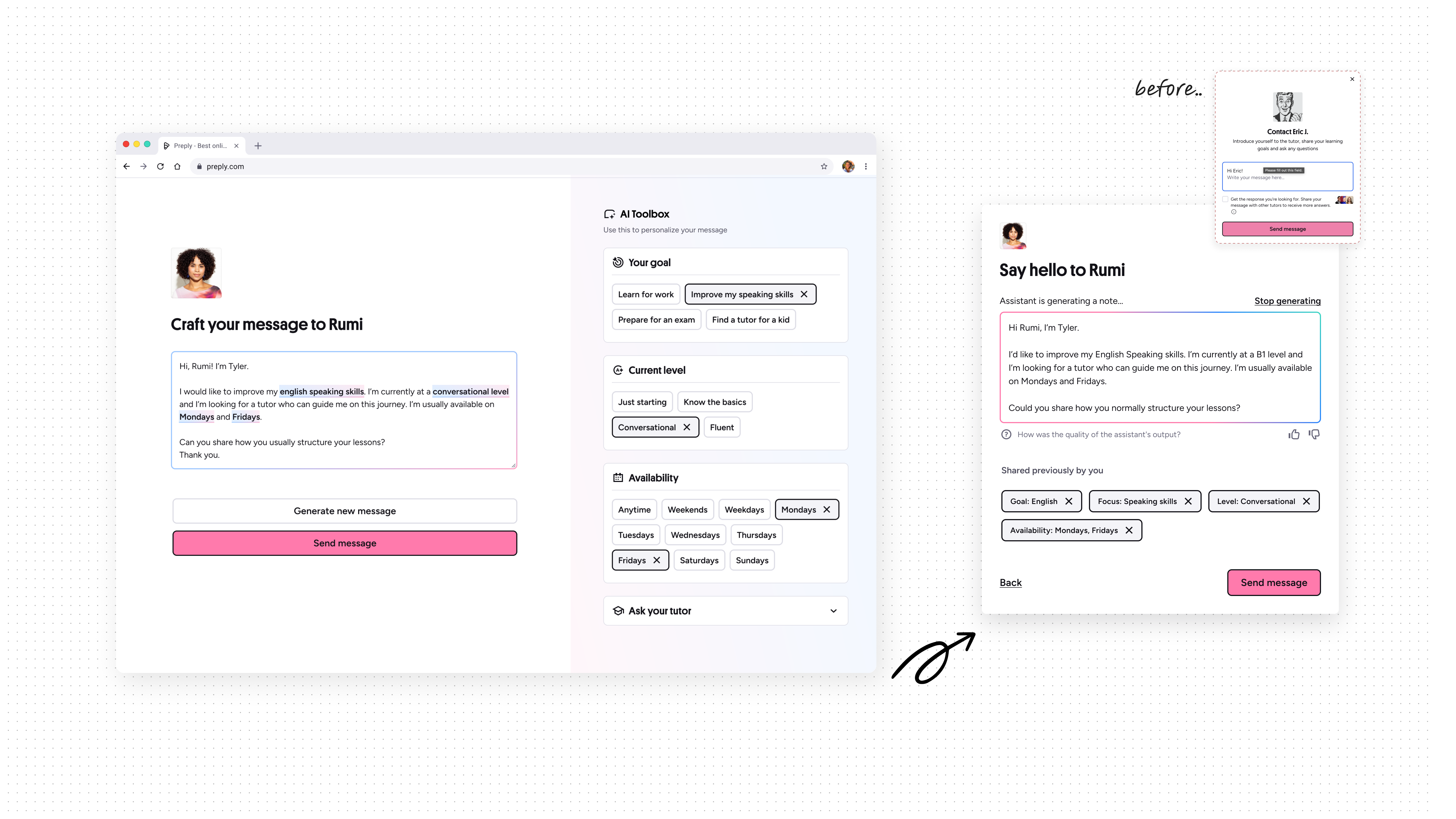
Leveraging existing learner data: Rather than asking learners to re-enter information, I designed the experience to reuse data already collected earlier in the funnel, such as goals, availability, and learning preferences. This reinforced continuity across the product and reduced cognitive load.


►

Exploring levels of AI involvement: I explored multiple concepts ranging from optional AI assistance behind a CTA to fully auto-generated drafts triggered on entry. These explorations tested different balances between user agency and automation.


►

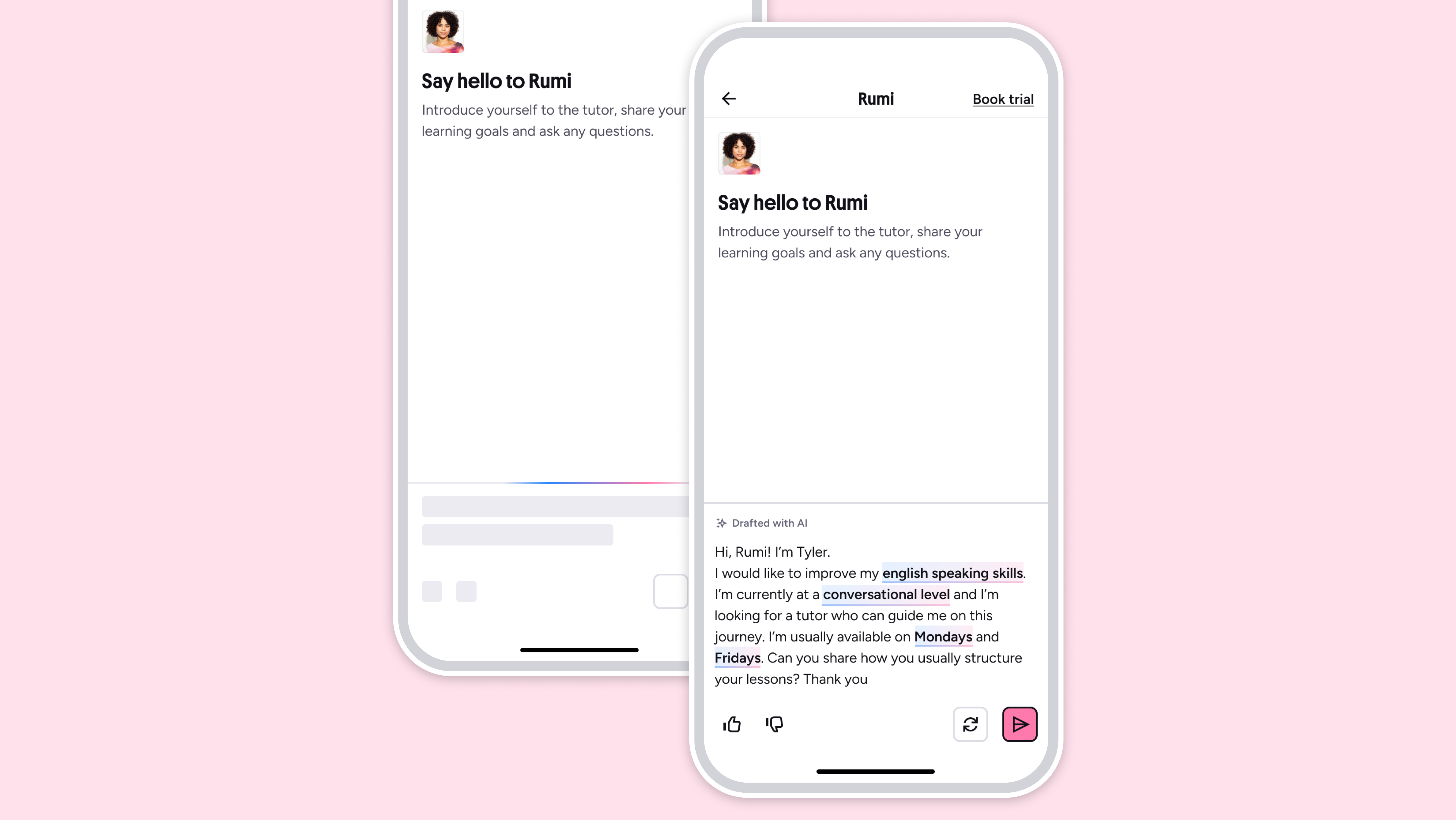
Validating through usability testing: I tested two primary concepts. One required users to explicitly request an AI-generated message, while the other automatically drafted a message using a typing animation. Testing showed that users rarely engaged with the manual CTA, but reacted positively and enthusiastically to the auto-drafted version.


►

Designing for control and trust: The final solution auto-drafts a message using AI, while allowing learners to edit freely, regenerate, or start from scratch. This preserved a sense of authorship while showcasing AI as a helpful assistant rather than a replacement.

design-aimessage


Outcome


The final design introduced AI into the tutor messaging flow in a lightweight, human-centered way. Learners responded positively to seeing a thoughtful, personalized message appear instantly, and appreciated being able to refine it rather than start from a blank state.


Beyond improving message quality, the project helped establish AI as a trusted companion in the learning journey and set a foundation for future AI-assisted interactions across the product.
  • hero0unified
  • Project 01

    Unified Add Lesson

  • hero-ai-message
  • Project 02

    AI First Message Flow

  • australia-mvp hero
  • Project 03

    Australia MVP

Let’s work together

© 2026

Home

Work

About

Jenni Ribeiro

Back to projects

AI First Message Flow

  • COMPANY

  • Preply

  • Role

  • Product Designer

  • Type

  • Experiment and AI intro

Explored an AI-powered first-message experience to help learners confidently reach out to tutors before booking a trial. The goal was to reduce friction in an underexplored part of the funnel, increase learner confidence, and introduce AI as a supportive, trust-building tool early in the learning journey. This project focused on turning an informal but high-impact behavior into a guided, delightful experience that feels natural, helpful, and fully under user control.

hero-ai-message

The problem


Many learners contact tutors before booking a trial as a way to assess fit, clarify expectations, or introduce themselves. These conversations strongly correlate with trial bookings, yet the experience of writing the first message was entirely unstructured.


Learners often repeated information they had already shared earlier in the funnel, felt unsure about what to say, or defaulted to short, low-quality messages that did not fully represent their learning goals.


Key challenges


Designing an AI-assisted experience that genuinely helped learners without feeling intrusive, overwhelming, or distracting from the main task.


We needed to balance guidance and automation with user control, and introduce AI in a way that felt supportive rather than prescriptive, especially at such an early stage of the funnel.


explores-aimessage


My role and responsibilities


I led the end-to-end design of the AI-assisted messaging experience, including problem definition, competitive benchmarking, interaction design, usability testing, visual design, and cross-functional collaboration. I worked closely with product, research, and engineering partners to shape a solution that balanced usability, trust, and scalability.


video-unified prototype


The approach


►

Understanding the behavior and opportunity: I started by analyzing how learners use messaging today, identifying it as a confidence-building step rather than a transactional one. This reframed the experience as a moment to support expression, not just communication.


►

Leveraging existing learner data: Rather than asking learners to re-enter information, I designed the experience to reuse data already collected earlier in the funnel, such as goals, availability, and learning preferences. This reinforced continuity across the product and reduced cognitive load.


►

Exploring levels of AI involvement: I explored multiple concepts ranging from optional AI assistance behind a CTA to fully auto-generated drafts triggered on entry. These explorations tested different balances between user agency and automation.


►

Validating through usability testing: I tested two primary concepts. One required users to explicitly request an AI-generated message, while the other automatically drafted a message using a typing animation. Testing showed that users rarely engaged with the manual CTA, but reacted positively and enthusiastically to the auto-drafted version.


►

Designing for control and trust: The final solution auto-drafts a message using AI, while allowing learners to edit freely, regenerate, or start from scratch. This preserved a sense of authorship while showcasing AI as a helpful assistant rather than a replacement.


design-aimessage


Outcome


The final design introduced AI into the tutor messaging flow in a lightweight, human-centered way. Learners responded positively to seeing a thoughtful, personalized message appear instantly, and appreciated being able to refine it rather than start from a blank state.


Beyond improving message quality, the project helped establish AI as a trusted companion in the learning journey and set a foundation for future AI-assisted interactions across the product.

  • hero0unified
  • Project 01

    Unified Add Lesson

  • hero-ai-message
  • Project 02

    AI First Message Flow

  • australia-mvp hero
  • Project 03

    Australia MVP

Let’s work together